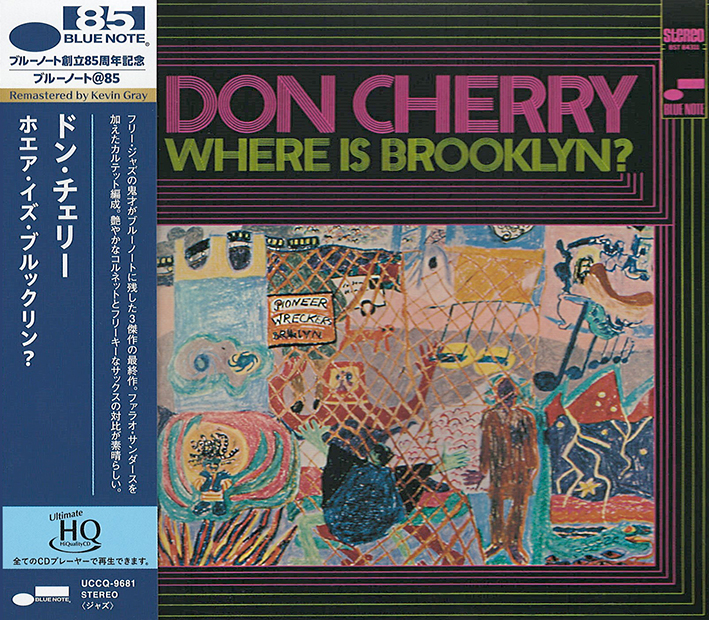
Don Cherry – Where is Brooklyn? (UHQCD)
| Selectați o variantă | |
| Termen de retur 14 zile |
102lei
Descriere
Blue Note founders Alfred Lion and Francis Wolff were open to new ideas, which they proved time and again in the early 1960s when they signed some of the most experimental musicians on the modern jazz scene, including Andrew Hill, Eric Dolphy, and Tony Williams. But it wasn’t until they brought Ornette Coleman and Don Cherry to Blue Note in 1965 that they dove headfirst into the avant-garde. Coleman and Cherry had, of course, already made history together years earlier when, as part of Coleman’s revolutionary quartet, they took the New York jazz scene by storm with their performance at the Five Spot Café in 1959, showing them that there was something new in town. Although Cherry released the album “The Avant-Garde” with John Coltrane in 1961, his career as a bandleader began with his bold Blue Note debut “Complete Communion”, recorded in December 1965 (Coleman had documented his new trio live at the Golden Circle in Stockholm just a few weeks earlier for his own Blue Note debut). In the fall of 1966, Cherry returned to Van Gelder Studio twice, first to record his extensive work “Symphony For Improvisers”, then for the fiery “Where Is Brooklyn?”. The latter was a highly interactive quartet session with Pharoah Sanders on tenor saxophone and piccolo, Henry Grimes on bass, and Ed Blackwell on drums, featuring five Cherry originals, including “Awake Nu” and “The Thing”.
As part of the extremely popular “Blue Note 85th Anniversary Reissue Series” Universal Music Japan presents the sonically impressive remastering of this jazz classic by the legendary Kevin Gray, who is also responsible for Blue Note US’s analog reissues such as “Tone Poet” and “Classic Vinyl” – as a limited Japan only UHQCD with OBI stripe. The original recording sessions for “Where Is Brooklyn?” took place on November 11, 1966 at Rudy Van Gelder Studio in Englewood Cliffs, New Jersey.
UHQCD stands for Ultimate High Quality Compact Disc and is a joint development of the Japanese CD replication company Memory-Tech and the Audio Quality CD Company from Hong Kong. Unlike conventional CDs, UHQCDs are not pressed from polycarbonate, but cast from a photopolymer and cured with UV light. Another layer of high-purity polycarbonate is applied to the softer photopolymer for scratch protection. The combination results in significantly reduced reflection of laser light inside the CD and an unmatched precise edge transition between pits and lands of the CD. UHQCDs are 100% compatible with standard CD players. Musically, the result is a sound image strongly reminiscent of analog master tapes.
While Universal Music Japan’s first UHQCD series relied on the DSD data of previous SHM-SACD releases, with increasing popularity, albums that had not previously been released as SHM-SACD are now appearing. Typically, the Universal Archive master tapes are re-converted to DSD for this purpose. UHQCDs are ideal for music lovers who want to get as close as possible to the sound of the recording, but do not own an SACD player.
Lista pieselor
UHQCD
1. Awake Nu
2. Taste Maker
3. The Thing
4. There Is The Bomb
5. Unite
Informații suplimentare
| Artist | Don Cherry |
|---|---|
| Format | UHQCD |
| Gen muzical | Jazz |